


Quick answer
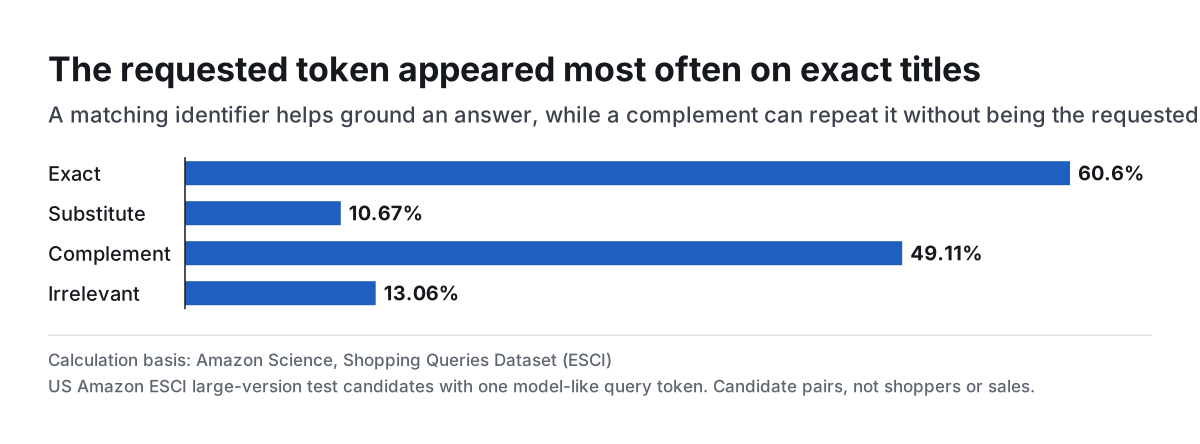
In the US Amazon ESCI test slice for queries with one model-like token, 60.6% of exact candidate titles contained the token, versus 10.67% of substitute titles and 49.11% of complement titles. A token match is useful evidence to check alongside the catalog’s product type and fit.
Key findings and sources
Exact products repeated the requested token on about six in ten titles
Checkout Reply’s Amazon ESCI reanalysis found the same model-like token in 1,569 of 2,589 US exact candidate titles (60.6%) on queries with one distinct model-like token.
Amazon Science, Shopping Queries Dataset (ESCI)
US large-version test candidates whose Amazon ESCI query contains exactly one distinct model-like token Check title token set membership, then divide by exact candidate pairs.
Substitutes repeated the token on 10.67% of titles
In the US model-like query slice of Amazon ESCI, 217 of 2,034 substitute titles (10.67%) repeated the exact query token.
Amazon Science, Shopping Queries Dataset (ESCI)
US large-version test candidates whose Amazon ESCI query contains exactly one distinct model-like token Divide matching titles by all substitute candidate pairs in the lexical slice.
Complement titles repeated the requested token more often than substitutes
In the US Amazon ESCI model-token slice, 165 of 336 complement candidate titles (49.11%) repeated the token, against 217 of 2,034 substitute titles (10.67%).
Amazon Science, Shopping Queries Dataset (ESCI)
US large-version test candidates whose Amazon ESCI query contains exactly one distinct model-like token Compare matching-title shares within the two published judgment classes.
Exact and substitute title token matches differed by about 50 points
The model-like token match share in this Amazon ESCI reanalysis was 49.93 percentage points higher among exact than substitute candidate titles. A lexical match does not verify compatibility.
Amazon Science, Shopping Queries Dataset (ESCI)
US large-version test candidates whose Amazon ESCI query contains exactly one distinct model-like token Subtract the unrounded substitute share from the unrounded exact share.
Compare the results
The requested token appeared most often on exact titles
A matching identifier helps ground an answer, while a complement can repeat it without being the requested item.
An identifier can describe the item or the item it fits
A shopper looking for a printer cartridge may include the printer model in the query. A title repeating that code could describe the cartridge, a refill accessory or the printer itself. The same text is evidence of a relationship, and the type of relationship determines what belongs in the cart.
That distinction appears in this benchmark. Among exact candidates, 1,569 of 2,589 titles contained the requested token. Among substitutes, 217 of 2,034 did. Complement candidates repeated it more often than substitutes in this slice. A recovery assistant can use a title token to locate a catalog record, then check the record’s role before calling the result a replacement.
Separate a missing token from a conflicting one
A title with no detectable model token leaves a question open. A title carrying a different code creates a specific conflict to investigate. Neither state confirms whether the catalog variant is wrong, since a title can omit a valid fit or list the manufacturer’s alternate identifier.
The useful report has three states: requested code present, other code only, and code not stated. Keep each denominator visible. An exact listing with a truncated title and a substitute that explicitly names another model deserve different follow-up wording.
Write the fallback before offering a replacement
For a compatibility-sensitive cart, confirm the buyer’s device or part number against a variant field or a fit list. If the records cannot establish fit, ask one short question and retain the original cart. If the record verifies the alternative, say which model it fits and how its size, pack or price differs.
Log these checks separately from clicks. Review a sample of recommendations by relevance and evidence state, then count how many were confirmed by structured records. This study supplies a benchmark for the evidence pattern. The merchant’s catalog and observed return reasons are the tests for whether their own reply policy needs changing.
Study data
| Measure | Value | Context |
|---|---|---|
| Exact candidate pairs | 2,589 query-product pairs | Replayed Parquet join |
| Exact distinct query IDs | 321 queries | Replayed Parquet join |
| Exact titles with no model-like token | 441 query-product pairs | Replayed Parquet join |
| Exact titles with a different token | 579 query-product pairs | Replayed Parquet join |
| Exact titles containing the requested token | 1,569 query-product pairs | Replayed Parquet join |
| Exact title token match | 60.6% | Original recomputed share or rate |
| Substitute candidate pairs | 2,034 query-product pairs | Replayed Parquet join |
| Substitute distinct query IDs | 247 queries | Replayed Parquet join |
| Substitute titles with no model-like token | 756 query-product pairs | Replayed Parquet join |
| Substitute titles with a different token | 1,061 query-product pairs | Replayed Parquet join |
| Substitute titles containing the requested token | 217 query-product pairs | Replayed Parquet join |
| Substitute title token match | 10.67% | Original recomputed share or rate |
| Complement candidate pairs | 336 query-product pairs | Replayed Parquet join |
| Complement distinct query IDs | 90 queries | Replayed Parquet join |
| Complement titles with no model-like token | 91 query-product pairs | Replayed Parquet join |
| Complement titles with a different token | 80 query-product pairs | Replayed Parquet join |
| Complement titles containing the requested token | 165 query-product pairs | Replayed Parquet join |
| Complement title token match | 49.11% | Original recomputed share or rate |
| Irrelevant candidate pairs | 697 query-product pairs | Replayed Parquet join |
| Irrelevant distinct query IDs | 129 queries | Replayed Parquet join |
| Irrelevant titles with no model-like token | 322 query-product pairs | Replayed Parquet join |
| Irrelevant titles with a different token | 284 query-product pairs | Replayed Parquet join |
| Irrelevant titles containing the requested token | 91 query-product pairs | Replayed Parquet join |
| Irrelevant title token match | 13.06% | Original recomputed share or rate |
What changes when you compare the figures
| Comparison | Result | Calculation |
|---|---|---|
| Exact title token match | 60.6% | = 1569 / 2589 * 100 |
| Substitute title token match | 10.67% | = 217 / 2034 * 100 |
| Complement title token match | 49.11% | = 165 / 336 * 100 |
| Irrelevant title token match | 13.06% | = 91 / 697 * 100 |
| Exact minus substitute token match | 49.93 percentage points | = (1569 / 2589 - 217 / 2034) * 100 |
| Complement minus substitute token match | 38.44 percentage points | = (165 / 336 - 217 / 2034) * 100 |
| Requested token among substitute titles that state a token | 16.98% | = 217 / 1278 * 100 |
| Requested token among exact titles that state a token | 73.04% | = 1569 / 2148 * 100 |
Methodology and sources
Filter Amazon ESCI to large-version US test pairs. Lowercase query and title and extract distinct whole tokens matching [a-z]{1,6}-?[0-9]{2,6}[a-z0-9-]{0,6}. Retain queries with exactly one token. Join the products table on product ID and locale. Split titles into no model-like token, one or more tokens but no query token, or at least one exact token match. Count each judged pair within its published relevance class. Case is normalized, punctuation is not. This detects strings such as SKU-like identifiers and may also detect dimensions or other mixed codes. It does not inspect descriptions, live variant fields or compatibility records.
Download the source data (CSV)
Download the calculations (CSV)
Download the citation notes (CSV)
Download the evidence behind the new findings (CSV)
Related reading
Long-tail ecommerce search statistics for exact matches and substitutes
AI shopping recommendation accuracy statistics
Ecommerce product review statistics and what shoppers use to decide
Sources and definitions
Amazon Science, Shopping Queries Dataset (ESCI)
The source data includes the population, period, denominator and limitations for every figure.